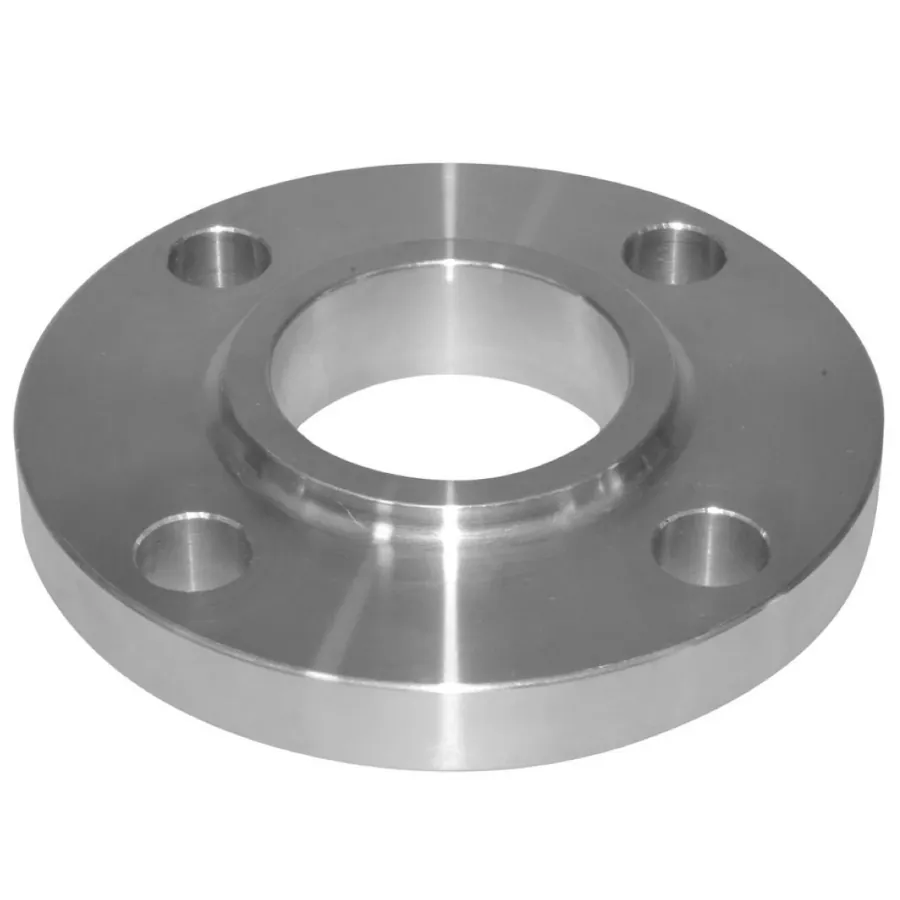
Two of the most common flanges on a small bore line look similar on a drawing and behave very differently in service. The choice between them is usually settled by pressure class, by how the joint will be inspected, and by what the welder can reach.
What actually separates them
A socket weld flange has a recessed bore. The pipe drops into the socket and is fillet welded around the outer edge only, which leaves the inside of the joint smooth. A slip-on flange sits over the outside of the pipe and is welded on both the inside and the outside face.
That single difference drives almost everything else. The socket weld joint is stronger and cleaner internally, so it suits higher pressure. The slip-on needs no precise pipe end preparation, so it is quicker and cheaper to fit.
Where each one belongs
- Socket weld. Small bore and high pressure. Typically half an inch to two inches, rarely above four. Steam and condensate, high pressure water, chemical and hydraulic service.
- Slip-on. Modest pressure where fitting cost and speed matter more than ultimate strength. Water lines, firefighting, HVAC and general utilities.
The detail that causes most of the failures
When a socket weld joint fails early, the cause is very often the same one. The pipe was bottomed out in the socket before welding.
Leave roughly one sixteenth of an inch, about 1.6 mm, between the pipe end and the socket shoulder. That gap lets the pipe expand into the socket as the weld cools. Without it the weld root carries the thermal stress directly and cracks, sometimes months later, on a joint that passed inspection on the day.
Before you specify
Check the pressure class first, then the bore, then how often the joint has to come apart. A joint that will be opened for inspection every outage may be better served by a lap joint or a threaded flange than by either of these.
Our flanges and gaskets range covers socket weld, blind, slip-on, lap joint, weld neck and threaded flanges to ASME B16.5 and B16.47.